Picture


I'm pleased to announce that the grand opening of the co-designed homes at the Pinoleville Pomo Nation
will featured in an Open House next Friday, Sept. 21 in Ukiah, CA at 10 am.  

Please come if you can!!!

Since March 2008, the Community Assessment of Renewable Energy and Sustainability (CARES) has been partnering with the Pinoleville Pomo Nation (PPN) near Ukiah, CA to co-design culturally-inspired, sustainable housing and renewable energy power systems that utilize sustainability best practices, renewable energy technology, and reflect the long-standing culture of the Pinoleville Pomo Nation.

During that time, this partnership has secured roughly $1.5 million via CITRIS, DOE, HUD, and EPA for construction and funded 2 PhDs and 2 MS projects in the College of Engineering and the Department of Architecture.

Two of the co-designed homes have been built and the PPN conducted “green jobs” training sessions on strawbale construction materials, grey water, and renewable energy systems for its citizens and local labors participating in their construction.  

This partnership has been honored with the 2010 Chancellor’s Award for Public Service in the Civic Engagement and has also been featured in UC Berkeley’s College of Engineering's Innovations (October 2008), College of Engineering's Engineering News (December 2008), College of Engineering's ForeFront (Spring 2009), and the University Relations’ Promise of Berkeley (Fall 2009). 

Also see Luce video of the project here.



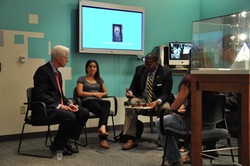
On Friday, I had the pleasure of attending a talk abot Prop 23 by Van Jones.


He gave an excellent lecture on perils associated with rolling back the progress California has made in the areas of renewable energy and sustainability by passing Prop 23.


I also had the chance to speak with Van Jones more CARES (Community Assessment for Renewable Energy and Sustainability) and or work with our tribal partners. 

Van Jones is a globally recognized, award-winning pioneer in human rights and the clean-energy economy. He co-founded three successful non-profit organizations: the Ella Baker Center for Human Rights, Color of Change and Green For All. He also served as White House environmental adviser for Obama.

Picture
Speaking with Van Jones about CARES
 
 
Today, I had a great opportunity to speak with Gov. Gray Davis about my work with the Pinoleville Pomo Nation during the unveiling of his plaque in the CITRIS Headquarters.

During his time as Governor, Gov. Davis championed energy efficiency and research in renewable energy technology.

He seemed to be really glad that there are researchers at Berkeley working in CITRIS to carry on some of his initiatives in the realm of energy.

Go here to see the full set of images from that day.
 
Picture
Gov. Davis and I talking about the PPN model
 
 
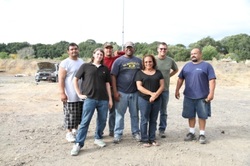
On Friday, September 17th 2010, I was able to work with members of the Pinoleville Pomo Nation to install a 20 m (60 ft) anemometer to measure the wind speed for power generation.

This work was fund by the Department of Energy and the Tribal Energy Program as apart of a renewable energy feasibility study grant the PPN received.

I had a great time working with everyone and I look forward to getting other CARES student to help out in the microhydro and pyranometer meters as well.

Please go here for the full set of images from that day.
Picture
The team after putting up the anemomter
 
 
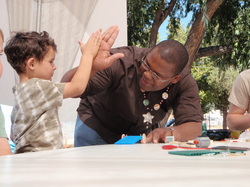
This past weekend, Josiah of RAEL and I went to the The Tuolumne Band of Mewuk Indians Acorn Festival and had solar energy booth.

We worked with the youth of the Mewuk and surrounding communities to design and build solar cars.

I had a lot of fun and I hope to continue to work with the Mewuk and RAEL.

Go here to see the full gallery of photos.
Picture
This is my favorite picture from this weekend:
 
 
Professor Alice Agogino, Mr. Daniel Wilson, and I will be teaching a freshman and sophomore seminar Engineering 39F entitled "Community Assessment of Renewable Energy and Sustainability (CARES)" .

This seminar is on CARES (Community Assessment of Renewable Energy and Sustainability) with application to the Pinoleville Pomo Nation.

CARES research has shown that living sustainably, having access to accurate environmental data, and having implementable solutions are of major concerns to consumers.

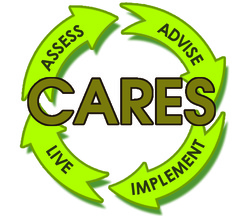
CARES seeks to help reduce climate change by being the first to close the loop of assessment, advisement and implementation of a more sustainable lifestyle.

This seminar will cover approaches to community assessment of renewable energy, with a focus on conservation, geothermal, microhydo-electric, solar photovoltaic, solar hot water heating, and wind energy.

We will also explore issues associate with creating a “green corridor” with electric vehicles in the San Francisco Bay Area with connections to Northern California tribes. Related website: http://best.berkeley.edu/ and http://www.planetcares.org/.
Enrollment is limited to ten students.
 
 
CARES is branching out to other Native American tribes in Northern California to work on sustainability and renewable energy related research.

In particular, we are starting to work with the Kashia Band of Pomo Indians located near Stewarts Point.

On Wednesday, August 11th, Kashia will be bringing 10 youths with ages ranging from 13 to 20 years to tour UC Berkeley.

CARES will be giving a tour of the CITRIS Technology museum and having a poster session during the lunch hour.

I would love if some of the BEST and BID students could talk about their work and eat lunch with the students.
The full schedule of event is here and pictures are here.
 
 
I was able to install the Black Cloud Air Quality Sensor at the Pinoleville Pomo Nation on Wednesday, July 21st 2010. 

The sensor records data on VOCs, CO2, Humidity, Vibration, Temperature, and Light.

You can check out the real time data here: http://www.blackcloud.org/alice/zurichtest_v2/
 
 
SWEET!!!  CARES won a $75K seed CITRIS grant to start a CARES center at Berkeley to codesign & build green it & energy systems for Native Nations.

The center will be called Native American Community Assessment for Renewable Energy and Sustainability (Native CARES) and will include Native American partners such as the Pinoleville Pomo Nation, the National Renewable Energy Laboratory (NREL), the Environmental Protection Agency (EPA), and Sandia National Laboratories.

Thanks to everyone that's supporting our efforts to helping  communities improve their overall level of sustainability and meet their triple bottom line requirements!

CARES has seen much success since we won the E Team grant in 2007 from NCIIA.  I believe that this grant is a another key step in establishing CARES as a major force in the sustainability arena.
 
 
This year, I spoke at the 2009 Greenbuild Conference in AZ on the panel "OR02: Reviving the Oldest Approach to Sustainable Design - How Cultural Values and a Sense of Place Leads to Green Building Designs"

The panel included myself, David Edmunds from the Pinoleville Pomo Nation (PPN), Michelle Baker from the Environmental Protection Agency (EPA), and Kimberly TallBear from UC Berkeley.

During our panel we spoke on about the partnership amongst CARES, PPN, and UC Berkeley and how the utilization of  Co-Design methodology lead to the creation of the culturally inspired  housing design adopted by the PPN.

Overall, Greenbuild was an outstanding success!!.  We got an standing ovation at the end of our panel and we made good contacts with representatives form LEED and USGBC.

Currently, we are planning for another panel and paper on the subject of LEED and Native American Nations for the summer as well.

Until then, check out some other comments and blogs about our presentation here and here.