Menu:

 
Picture


The 3rd Annual Gathering of the Pomo Nations for Higher Education will take place Friday, March 5th 2010 in Redwood Valley, CA.

It is a chance for junior and high school students to meet college representatives and get to know a little more about the exciting challenges that await them in higher education.

The conference will be located in the Consolidated Tribal Health Project, 6991 North State Street, Redwood Valley, CA 95470.

If you need more information, please contact 
Angela James at 707-463-1454 or at her email address: angelajames2276@yahoo.com


In March 2010, it will be two years since I started our partnership with the Pinoleville Pomo Nation (PPN).  In these past few years, CARES has been able to work with the PPN to co-design culturally inspired, sustainable housing for their members and secure funding to work development renewable energy power generation systems for their communities.

Now, we are trying to establish a more permanent relationship amongst the PPN, CARES, and UC Berkeley by seeking to create a center in CITRIS that uses the CARES model of (1) Assess, (2) Advise, (3) Implement, and (4) Live Sustainable.

This center is be called Native American Community Assessment of Renewable Energy and & Sustainability or NAtive CARES.  The center will focus on all aspects of sustainability that our tribal partners in Northern California are pursuing: green building, power generation, indoor air quality, water conservation, and economic business models.

I have been able to secure letters of support of the National Renewable Energy Lab , Sandia National Laboratories, and the Environmental Protection Agency to support this center.

I am really excited about our prospects for winning this CITRIS seed funding and I am looking forward to continuing the work that CARES has begun to improve the personal level of sustainability of all communities.


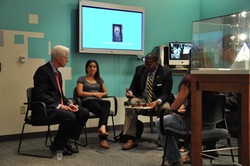
This year, I spoke at the 2009 Greenbuild Conference in AZ on the panel "OR02: Reviving the Oldest Approach to Sustainable Design - How Cultural Values and a Sense of Place Leads to Green Building Designs"

The panel included myself, David Edmunds from the Pinoleville Pomo Nation (PPN), Michelle Baker from the Environmental Protection Agency (EPA), and Kimberly TallBear from UC Berkeley.

During our panel we spoke on about the partnership amongst CARES, PPN, and UC Berkeley and how the utilization of  Co-Design methodology lead to the creation of the culturally inspired  housing design adopted by the PPN.

Overall, Greenbuild was an outstanding success!!.  We got an standing ovation at the end of our panel and we made good contacts with representatives form LEED and USGBC.

Currently, we are planning for another panel and paper on the subject of LEED and Native American Nations for the summer as well.

Until then, check out some other comments and blogs about our presentation here and here.
 
 
This is a repost of an article written about the closure of the NSF funded Center for Underpresented Engineering Students (CUES) at UC Berkeley.
Berkeley Engineering Dean Defends Student Services Shakeup  by Corinna Wu


Students and faculty members at the University of California, Berkeley, had a chance yesterday to air concerns about a major change in the status of diversity programs within the College of Engineering. But while Dean Shankar Sastry said he welcomed their input, he made it clear that his decision earlier this summer to fold the long-running Center for Underrepresented Engineering Students (CUES) into a revamped Engineering Student Services (ESS) office is a done deal.


"The decision to reorganize has been made," Sastry told some 60 people who attended a town hall meeting on campus. “I know that people are worried about change," he said, adding that "we will continue to have meetings like this." He also announced the formation of a faculty-student task force, to be headed by electrical engineering professor Ruzena Bajcsy, to provide ongoing advice.


Audience members pressed Sastry for details about why the change was being made and why he thought the new structure would benefit students. And they weren't happy with the answers they received. “I heard a lot of opposition from the students present and less-than-direct answers to many of their questions,” said Anne MacLachlan, a senior researcher at Berkeley’s Center for Studies in Higher Education and the final speaker in the 90-minute dialogue.


Sastry said that integrating the programs under CUES into ESS would help address a 40% drop since 2005 in the number of minorities and women entering the college. “I’d like to be able to make sure that the underrepresented student part of student advising is not an island. I’d love to bring it in a little tighter with the faculty and students of the college. …That is the biggest single reason to bring it in,” he said. Acting ESS Director Kristen Gates said that the college hoped to offer new programs in peer advising, outreach, internships, and research opportunities for freshmen.


MacLachlan worried that parents of prospective students could interpret the new structure as evidence that Berkeley does not welcome students of color, she said, and that their concerns could undermine the goal of increasing enrollment. Others questioned the timing of the transition. “What’s the hurry?” asked Caroline Kane, an emerita professor of biochemistry and molecular biology with the Coalition for Excellence and Diversity in Math, Science, and Engineering. “It seems like we're dropping a bomb right when we’ve got students coming back to the college of engineering who are used to having a community and community space,” she said.
 
 
Here is a repost of an article written today by Jeffery Mervis about the closure of CUES.

Debate Today on Engineering Diversity Program at Berkeley by Jeffery Mervis

"Unhappy students and faculty members at the University of California, Berkeley, are expected to jam a campus town hall meeting this afternoon to hear the dean of the college of engineering explain why he's dismantling a model program for underrepresented minorities and women.

In announcing the change last month, Dean Shankar Sastry said he hopes that melding the Center for Underrepresented Engineering Students (CUES) into a new Engineering Student Services (ESS) office will actually strengthen the college's efforts to promote diversity. The center’s three employees were told last month that their contracts would not be renewed, effective 30 September.

Although the university is under severe financial pressure, engineering officials say the reorganization is not being done for budgetary reasons and that ESS will not be jettisoning any staff positions. Karen Rhodes, head of marketing and communications for the engineering college, says that the school’s “yield”—the percentage of students deciding to enroll in the fall after being accepted in the spring—is much lower for incoming minority engineering students than it is for the campus as a whole. She says a study by an outside consultant also found that many engineering students were dissatisfied with the current level of services being offered. "We need to become friendlier and in tune with what they want,” says Rhodes.

In addition, the school has seen a sharp decline in the overall percentage of minorities in its entering class—from 11% in 2004 to 6% this fall. That "alarming trend," says Rhodes, has led the college to "rethink our approach to serving underrepresented minorities."

However, supporters fear that the needs of minority students and women will get lost in the reshuffle. A precursor of the center was begun in 1981, and its cluster of activities—which include a summer bridge program, undergraduate research experiences, and academic and career counseling—have been emulated over the years by several other top universities. CUES’s supporters say that the current statistics argue for more, not less, emphasis on the needs of those students and that eliminating the center as an independent entity sends a signal that the college is diluting its commitment to broadening participation.

"I was absolutely shocked when I first heard the news," says Stanley Prussin, a professor of nuclear engineering and a former associate dean who oversaw CUES in the late 1990s. "It's been a model for the rest of the campus and for the entire country. The number of underrepresented minorities [within the college] is not what you would like it to be, but the problems have not disappeared. If anything, the need for a more intensive and independent approach to the problem seems to be greater than ever."

Ryan Shelby, a doctoral student in mechanical engineering, says that CUES was a big reason he chose Berkeley. "I wanted to make sure I had a support system, and they showed me how much they care. Their sole mission is to increase diversity and minority participation in engineering. It's not just a collection of programs; it's their entire approach." Shelby is a leader in a student group that is asking the dean to conduct a more thorough review of the center's impact before making any changes."


U.S. Energy Secretary Steven Chu today announced today that the Pinoleville Pomo Nation will receive more than USD$100,000 to perform a renewable energy feasibility study to measure the microhydro, biogas geothermal, wind, and solar resources within it lands.

CARES will be working with the PPN to help complete these feasibility studies and generate a renewable energy roadmap . 

The link to the story can be found here.
 
 
Although I did not attend UC Berkeley for my undergraduate degree, I participated and received support from an organization similar to CUES at the University of Michigan while I was a visiting undergraduate research student from Alabama A&M University.   This organization allowed to experience first hand what it was like to be a graduate student and the wonders that come from conducting research at a graduate level.

The coordinators and administrators in this organization treated me like I was a person and not just another number on a checklist.  They interacted with me in a way that let me knew that they cared about me as a person and not just someone that can crank out papers for the next 5 years. My experience at Michigan during the summer of 2004 in this organization and its programs is really what made me decide to pursue my graduate studies. 

When it came to choosing which graudate school I wanted to attend, my first choice was the University of Michigan at Ann Arbor.  When I visited the University of Michigan, I knew that there were people and an organization present that were going to help guide and support me (emotionally, financially, and academically) throughout my graduate career.  

The University of Michigan invested time and money to bring me to their Dept of Mechanical Engineering to perform research at graduate level They even sent people down to my school, Alabama A&M University, to talk about the opportunities at Michigan and give them tips and techniques to apply to Michigan for graduate school or for the summer research opportunity program.

By having a organization and personnel solely dedicated to actively recruiting underrepresented students and helping me receive my graduate degree(s), I knew that the University of Michigan was serious about establishing and maintaining a diversified environment in its engineering programs. 

I was able to personally connect with the people at University of Michigan because I new they cared about me and my overall well being and success.  I felt a sense of loyalty to Michigan because of the kindness they bestowed upon me and the resources that committed to my success in graduate school at Michigan and other top tier schools.

The CUES organization and its programs at Berkeley are also identical twins to the organization and program at Michigan.  After I became familiar with CUES and its personnel, I knew that no matter what happened at Berkeley during my graduate career they would always be there to provide me a support network. 

The only reason I came to UC Berkeley over the University of Michigan was that the people I personally connected with at Michigan were going to retire few my first year in the Mechanical Engineering Department.

No matter where I went to school, I knew I was going to be successful.  However, I wanted to make sure that the graduate school I went also wanted me to be successful and was willing to support to me.  It was hard for me to say "No" to Michigan after all the things they had done for me, but I knew in my heart that I wanted to go to a school that cared about me as a person and was going to support me no matter what happens. There was not a doubt in my mind that CUES and the people that make of CUES would always be there for me while I was at Berkeley.

CUES is an organization whose solely purpose everyday is to recruit and graduate future engineers in the UC Berkeley's College of Engineering's undergraduate and graduate programs.

CUES is an excellent program that has had an extensive and successful track record of providing academic, social, and monetary support to students in their undergraduate and graduate endeavors as well.  It is, in a nutshell, a close knit family that cares about the academic, professional, and social well being of the people it serves. 

When I go to that office, I know that every person, every scrap of paper, and every dollar in that place is dedicated to one thing and one thing only: increasing the number of underrepresented groups such as women, Native Americans, African Americans, Hispanic Americans, and Latinos that attend and graduate from the  undergraduate and graduate programs in College of Engineering at UC Berkeley.

The ESS will never be CUES because its primary focus is not to increase the enrollment and the graduate rates of the above mention underrepresented groups.  In ESS, the focus on the above mentioned underrepresented groups will take a tertiary role at best. 

This move to reorganization/eliminate CUES is Dean Sastry's first statement and act about diversity at the College of Engineering.  What this move shows is that the College of Engineering no longer places a high priority on recruiting and graduating more women, Native Americans, African Americans, Hispanic Americans, and Latinos in the undergraduate and graduate programs in the College of Engineering at UC Berkeley.
 
 
Picture
Ryan Shelby in the ASMS Class of 2002


While searching the web for new mentions of CARES, I came across a high school project that I did at the Alabama School of Mathematics and Science.

The project was about testing the launch angle of a MIRV (Multiple Independently Targeted Reentry Vehicle).

Seeing this page brought back so many fond and amazing memories about my time at ASMS. 

ASMS was the best time of my life and it really influenced the person I am today.  I am very thankful for having the opportunity to attend this magnificent school and meet so many great friends!

I had so much fun taking classes, hanging out in the SAC, and waiting on Happy Quarter and Intervis. 


The Pinoleville Pomo Nation will be having their 14th Annual Big Time Celebration July 17th - July 18th in Ukiah, CA.

The Big Time celebration will have Bear Dancers as well as arts and crafts from numerous Native American tribes in the Northern California area. 

During the Big Time celebration, the Gathering of Pomo Nations for Higher Education Conference will take place as well.

This will have speakers and educational sessions to discuss the future educational opportunities for the junior high and high school students.

Please make plans to attend Big Time if you can. :)

Download Big Time and Educational Conference flyer.


Picture

Today, the House of Representatives passed the
American Clean Energy And Security Act of 2009 to reduce the United States' greenhouse gas emissions (GHGe) and encourage more renewable energy generation. 

This bill will establish a cap and trade system this will place a limit of the amount GHGe manufacturers and energy providers can emit within a year by giving these industries pollution permits or allowances.

The manufacturers and energy providers that exceed their pollution permits can trade pollution permits amongst themselves in order to avoid fines.

The cap on GHGe would increase over the years, which would in turn increase the price of emissions and driving these industries to find cleaner ways of making energy and products.

The bill has a goal of reducing GHGe in the United States to 17 percent below 2005 levels by 2020, and 83 percent by 2050.

In 2005, the United States emitted 7, 256.9 metric tons of carbon dioxide equivalent.  In 2007, the United States emitted 7,282.4 metric tons of carbon dioxide equivalent.

This bill is the first real step that the United States has taken to actually address the dangers of climate change.   It is by no means a perfect bill with all of its special pork projects, but it does create more momentum for the sustainability movement. 

Once we achieve enough momentum, we will be unstoppable just like the Juggernaut.  The key to achieve this is to keep up pressure on our government representatives. 

We must make sure that Congress and President Obama are designing policies that will encourage more sustainable and renewable energy technologies that will protect God's green earth and allow the citizen's of the United States to lead productive and effective lives.

Download the full bill here and read more here