Today, the House of Representatives passed the
American Clean Energy And Security Act of 2009 to reduce the United States' greenhouse gas emissions (GHGe) and encourage more renewable energy generation.
This bill will establish a cap and trade system this will place a limit of the amount GHGe manufacturers and energy providers can emit within a year by giving these industries pollution permits or allowances.
The manufacturers and energy providers that exceed their pollution permits can trade pollution permits amongst themselves in order to avoid fines.
The cap on GHGe would increase over the years, which would in turn increase the price of emissions and driving these industries to find cleaner ways of making energy and products.
The bill has a goal of reducing GHGe in the United States to 17 percent below 2005 levels by 2020, and 83 percent by 2050.
In 2005, the United States emitted 7, 256.9 metric tons of carbon dioxide equivalent. In 2007, the United States emitted 7,282.4 metric tons of carbon dioxide equivalent.
This bill is the first real step that the United States has taken to actually address the dangers of climate change. It is by no means a perfect bill with all of its special pork projects, but it does create more momentum for the sustainability movement.
Once we achieve enough momentum, we will be unstoppable just like the Juggernaut. The key to achieve this is to keep up pressure on our government representatives.
We must make sure that Congress and President Obama are designing policies that will encourage more sustainable and renewable energy technologies that will protect God's green earth and allow the citizen's of the United States to lead productive and effective lives.
Download the full bill here and read more here.
The 2009 Greenbuild International Conference & Expo’s program has been announced.
This conference is the largest dedicated to green buildings and their design. This year the conference will take place in Phoenix, AZ from November 11-13 2009.
I will be at the conference this year to serve on a panel to discuss the partnership between CARES and the PPN to build cultural inspired, sustainable. housing.
You can read more about our session here.
CARES got two news articles posted on the Mechanical Engineering Department's homepage!!!!
The articles talk about our win at the 2009 Bears Breaking Boundaries (BBB) and the recent Forefront publication of our work with the Pinoleville Pomo Nation.
Here is a link to the BBB and CITRIS competitions.

| 2009bearsbreakingboundariesfactsheet.pdf |
| File Size: | 50 kb |
| File Type: | pdf |
Download File
UC Berkeley's Forefront magazine released an article today that describes the work that the Community Assessment of Renewable Energy and Sustainability (CARES) is doing with the Pinoleville Pomo Nation.
CARES has partnered with the Pinoleville Pomo Nation (PPN) to co-design culturally inspired, sustainable homes for the PPN.
The homes resemble a yurt and will utilize grey water capture systems, rainwater capture systems, natural lighting, solar water heaters, PV systems, and geothermal heat pumps.
The yurt design will also incorporate passive heating and cooling systems such as high thermal mass and solar heating as well.
The construction of the home is set to begin this summer.
I will be presenting at this conference in a few days. The full program can be found here.
The focus of the talk will be on The Pinoleville Pomo Nation – UC Berkeley Partnership to Co‐Design Culturally Informed, Sustainable Housing.
The Department of Energy will be awarding the state of Massachusetts $25 million in funding from the American Recovery and Reinvestment Act to accelerate development of the state’s Wind Technology Testing Center.
The center will focus on the test and development of next generation wind turbine blades for the market.
According to a DOE’s 2008 report: “20% Wind Energy by 2030”, the US has an ample wind energy resource and it is technically feasible to wind energy to generate 20% of the nation's electricity demand by 2030.
The report's conclusions include:
1. Reaching 20% wind energy will require enhanced transmission infrastructure, streamlined siting and permitting regimes, improved reliability and operability of wind systems, and increased U.S. wind manufacturing capacity.
2. Achieving 20% wind energy will require the number of turbine installations to increase from approximately 2000 per year in 2006 to almost 7000 per year in 2017.
3. Integrating 20% wind energy into the grid can be done reliably for less than 0.5 cents per kWh.
4. Achieving 20 percent wind energy is not limited by the availability of raw materials.
5. Addressing transmission challenges such as siting and cost allocation of new transmission lines to access the Nation's best wind resources will be required to achieve 20% wind energy.
The last point is the most interesting to me. If you look at the 50 meter US wind energy resource map, you will see that all lot of the wind energy is located in areas on or near Native American lands.
I wonder if we will do it right this time and actually partner with Native American communities to setup wind farms that will provide economical, environmental, and tribal sovereignty benefits.
Ideally, these Native American communities should secure funding to set up their own energy companies and transmit any excess energy to the power grid.
Energy Secretary Steven Chu said today that the Obama administration's budget will not contain any funding for developing hydrogen powered vehicles.
It seems that the Obama administration wants to focus on alternative energy technology that can be developed quickly. Right now, plug-in hybrids and all-electric vehicles right winning the popularity contest.
Both technologies, however, have serious infrastructure issues that must be address before we will see a national wide adoption.
The main barriers to plug-in hybrids and all-electric vehicles are the production of lithium batteries, recharging time, recharging stations, and the vehicle range.
The main barriers to hydrogen powered vehicle are the production of hydrogen and fuel cells, the distribution of hydrogen, and the on board vehicular storage of hydrogen (300 mile range).
For MS, I worked at Lawrence Livermore National Laboratory (LLNL) to design and test hydrogen storage technologies.
The team created a cryogenic capable pressure vessel (CCPV) that can store 10.7 kg of liquid hydrogen. This system was tested in a Toyota Prius in January 2007 and it achieved a 653 mile range.
Lets not forget that both technologies are just passing the buck when it coming to emissions.
Most of the hydrogen produced in the United States is made from the steam reformation of natural gas (methane). Currently, ~ 49% of the electricity produced in the US comes from coal-fired plants.
While I agree that it is probably easier and less costly to set up the infrastructure for plug-in hybrids and all-electric vehicles, I still do not believe this is the best way forward.
Right now, the Telsa Roadster can travel 244 miles (393 km) without external loads on the battery, i.e. no A/C running, no radio turned on, no phone or Ipod charging,...... You get the picture.
Furthermore, it takes 3.5 hours to fully recharge the Roadster. When I think about the usage phase of a car, electric vehicles just don't appeal to me. The recharge time is too long for my preferences and I am unsure about the actual range of these vehicle under "normal" stop and go driving conditions.
The system design at LLNL was flexibly refuelable. The CCPV can store compressed hydrogen gas at room temperature, compressed hydrogen gas at 80 degrees K (all gases occupy less volume at colder temperatures), and liquid hydrogen (LH2) at 20.28 K.
This allows a user to decide which fuel type they need based off of driving requirements and cost. If users wanted to travel short distances (~120 miles), they could choose hydrogen at room temperature. This is the cheapest to produce, but you store less hydrogen in the system.
If users wanted to travel further than 300 miles, they choose LH2. It is the most expensive to produce but you store more in the system for extended ranges: ~300 to ~500 miles. The refuel system is similar to the current gasoline system and can be completed under 5 minutes.
I would be a raging supporter of electric vehicles if (1) the electricity comes form renewable energy sources, (2) the recharging time was reduced to at least 30 mins, and (3) the range is equal to that of an internal combustion engine (300 miles or more).
Right now, I am for continuing development of both technologies and letting the range, cost, and emissions performance decide the winner.
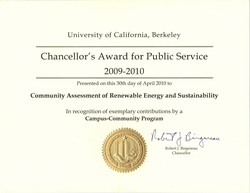
Out of over 400 submissions at the Bears Breaking Boundaries competition, the Pinoleville Pomo Nation project won honorable mention in the Curricular Innovations category and CARES (Community Assessment of Renewable Energy and Sustainability) was a finalist in the Information Technology category.
We did not win the main prizes, but we made good contacts!!
See everyone again next year at BBB.
The title says it all!! The poster session will take place in the atrium of the new CITRIS headquarters building at UC Berkeley.
Here is the link again: http://www.citris-uc.org/events/Big-Ideas-poster2009
Come on out and support CARES!
I got more good news:
The Greenbuild 2009 Program Committee informed me today that proposal I wrote with the EPA and PPN: Reviving the Oldest Approach to Sustainable Design: How cultural values and a sense of place lead to green building designs has been accepted.
There were 1300 submitted and our proposal was one of the 112 that got in.
The proposal talks about the co-design process CARES used to work with the PPN to co-design culturally inspired, sustainable housing.
I write so many of things things that I completely forgot about this one. :)